Political Prisoner of Antarctica: Russia Detains Ukrainian Scientist for Opposing Its Stance on the Southern Ocean
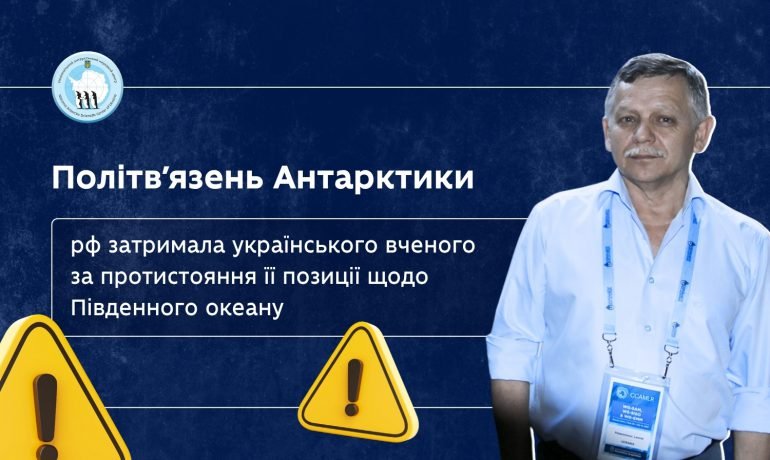
In the temporarily occupied Crimea, Russian authorities have detained and charged Ukrainian marine biologist Leonid Pshenichnov with high treason. He has thus become the first political prisoner in the history of Antarctica, as his arrest is directly linked to his opposition to Russia’s exploitative position regarding the Southern Ocean.
For many years, Pshenichnov worked at the Southern Research Institute of Marine Fisheries and Oceanography in Kerch. In 2015, he moved to the Institute of Fisheries and Marine Ecology in Berdyansk, and later to its successor — the Institute of Fisheries, Marine Ecology and Oceanography in Kyiv. Despite continuing to live in Crimea with a Ukrainian passport, he was unable to leave due to family circumstances.
Pshenichnov’s field of expertise is the biological resources of the Southern Ocean. He has authored numerous international scientific papers on the assessment of Antarctic krill stocks and the biodiversity of ichthyofauna.
Given his extensive expertise, as early as 1996 he was invited to represent Ukraine at the Commission for the Conservation of Antarctic Marine Living Resources (CCAMLR) — an international body tasked with implementing an ecosystem-based approach to managing marine resources and preventing their overexploitation.
The Commission approves quotas for the harvesting of Antarctic krill and commercial fish species, and develops measures to protect the living marine resources of Antarctica, including the establishment of Marine Protected Areas (MPAs) — specially protected regions of the Southern Ocean.
Until 2025, Pshenichnov actively participated in the Commission’s work as Ukraine’s official representative and served as the technical coordinator of scientific observation programs aboard Ukrainian fishing vessels operating in Antarctic waters. He was also among the authors of Ukraine’s proposal to create a new Marine Protected Area near the Antarctic Peninsula, close to the Vernadsky Research Base.
Unfortunately, this initiative — like other MPA proposals — has been consistently blocked for years by China and Russia, both of which question not only the establishment of new protected areas but also the legitimacy of existing ones.
In September 2025, just before the next CCAMLR meeting, Russian authorities arrested Pshenichnov, labelling him a “Russian citizen” as part of their forced “passportization” of Crimea’s residents. He was accused of state treason and causing economic harm to Russia. In particular, his proposal to create a Marine Protected Area was interpreted as an attempt to restrict Russian industrial fishing and reduce its control over a strategically important sector of the global ocean.
At this year’s CCAMLR meeting, currently taking place in Hobart, Australia, Ukraine’s Ambassador to Australia Vasyl Myroshnychenko called on member states to draw attention to the unlawful imprisonment of Pshenichnov and to support Ukraine’s demand for his immediate release.
The Australian delegation, as the host of the meeting, condemned the detention of the Ukrainian scientist. The European Union, Norway, the United Kingdom, New Zealand, and South Korea also expressed solidarity with Ukraine’s position.
The global scientific and environmental community is urged to stand in defense of this prominent Ukrainian researcher of international standing. In 2021, CCAMLR formally recognized Leonid Pshenichnov’s over 20 years of contribution to its work — yet today, he remains behind bars.
Pshenichnov recently turned 70 years old and suffers from serious health issues. Any delay in securing his release could prove critical.
Share the news

