How War Changes the Atmosphere: NASU Scientist Investigates the Spread of Pollution and Its Impact on Weather Processes
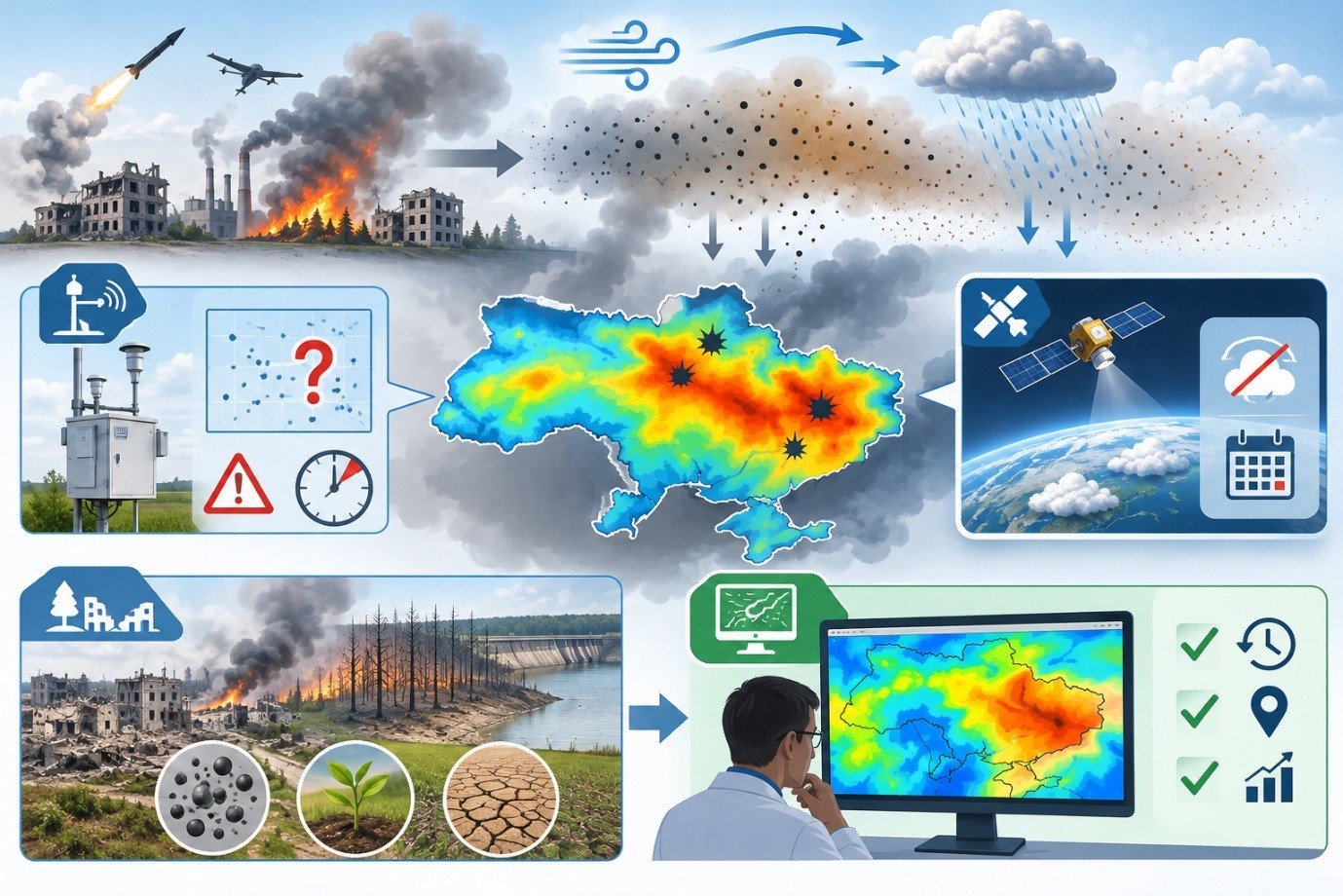
Emissions from shelling and fires can travel tens of kilometres, contaminate soils and water bodies, and even temporarily alter local weather conditions. How can these impacts be assessed when a significant proportion of the pollution remains undetected by monitoring systems? A Ukrainian scientist has proposed a new approach to addressing this challenge.
Mykhailo Savenets, Head of the Atmospheric Monitoring Department at the Ukrainian Hydrometeorological Institute of the State Emergency Service of Ukraine and the National Academy of Sciences of Ukraine (NASU), and Candidate of Geographical Sciences, has developed a methodology for using numerical models to reconstruct the impact of military activities on ambient air quality with high spatial and temporal resolution.
The need for such an approach arises from the limitations of conventional monitoring methods. Some pollutants disperse within just a few hours, while others travel considerable distances and undergo various chemical reactions in the atmosphere. Ground-based monitoring stations record air quality only at specific locations, while satellite observations are limited by cloud cover and insufficient measurement frequency. As a result, a significant proportion of the environmental consequences of shelling remains undocumented.
The proposed methodology is based on the use of so-called “seamless”, or integrated, modelling. Unlike conventional approaches, it takes into account the interactions between pollutants, meteorological processes, and changes in the Earth's surface caused by the war.
What did the modelling reveal?
To test the methodology, the researcher used the Enviro-HIRLAM numerical model to reconstruct atmospheric processes during active hostilities in eastern Ukraine from 7 to 10 May 2022.
The results showed that ecosystem fires near combat zones made the largest contribution to the modelled aerosol pollution. High concentrations of carbon-containing particles, particularly black carbon (soot) and organic carbon, were detected at altitudes of up to 3 km, while fine particles could be transported tens of kilometres from their emission sources.
The modelling also made it possible to assess the deposition of pollutants onto the Earth's surface. According to the calculations, under the conditions studied, approximately 3 kg of carbon-containing aerosols were deposited per square kilometre of surface area per day, on average.
Another important finding concerns the impact of pollution on atmospheric processes. In areas affected by smoke from fires and shelling, particulate matter absorbed and scattered solar radiation.
As a result, the amount of solar radiation reaching the Earth's surface decreased by an average of 15–45 W/m². Under certain conditions, near-surface air temperatures could temporarily drop by 0.1–1°C, accompanied by a subsequent weakening of vertical air mixing.
At the same time, the researcher emphasises that these changes are local and short-lived. He also points out that military activities simultaneously generate additional greenhouse gas emissions, producing the opposite effect at the scale of the climate system.
Why is this reconstruction important?
The developed methodology makes it possible to reconstruct the spatial distribution of pollutants at three-hour intervals, distinguish aerosol particles by their chemical composition and size, and assess their deposition onto the Earth's surface.
This opens up opportunities for a more comprehensive assessment of the environmental consequences of war, particularly the interconnections between air, soil and water pollution and impacts on ecosystems. Such calculations may also help improve methods for assessing environmental damage.
Nevertheless, fully reconstructing the impact of the war remains a challenging task. Not all emission sources can be accurately identified and reconstructed, and the modelling itself requires substantial computational resources. Test calculations were performed on European supercomputers, including those operated by Finland's CSC – IT Center for Science.
According to the researcher, modelling the entire period of Russia's full-scale invasion would require several hundred thousand euros. Therefore, conducting such research through international cooperation is a promising way forward.
The research was carried out within the project “Development of a Methodology for Applying Seamless Numerical Models to Assess the Impact of Military Activities on Ambient Air Quality” (No. 2025.05/0005). The project was supported by a Grant of the President of Ukraine for research and development by young scientists holding PhD and Candidate of Sciences degrees, following a competition organised by the National Research Foundation of Ukraine.
For more information about the methodology, test modelling results and prospects for its application, Mykhailo Savenets has prepared a series of five popular science publications entitled “Model-Based Reconstruction of the Impact of War on Ambient Air Quality”, published on the Institute's website:
Share the news

