Archaeologists of the Academy Complete the Fourth Field Season of Research in the Centre of Odesa
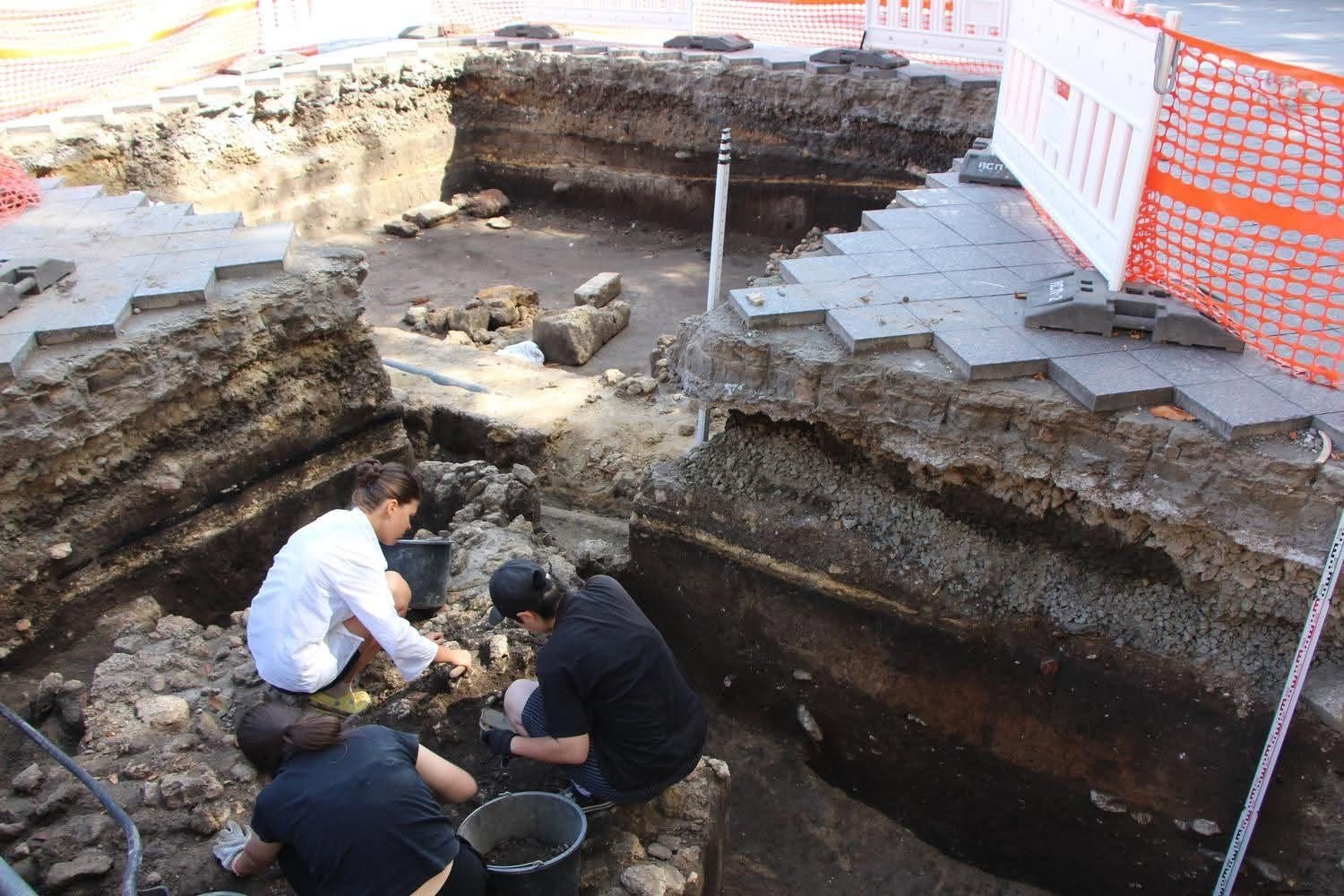
The Odesa Archaeological Expedition of the Institute of Archaeology of the National Academy of Sciences of Ukraine, in cooperation with the K. D. Ushynsky South Ukrainian National Pedagogical University (expedition leaders: Svitlana Ivanova, Doctor of Historical Sciences, Leading Researcher of the Department of Archaeology of Crimea and the North-Western Black Sea Region at the Institute of Archaeology of the NAS of Ukraine, and Andrii Krasnozhon, Doctor of Historical Sciences, Rector of the K. D. Ushynsky South Ukrainian National Pedagogical University), has completed the fieldwork stage of research at the two-layer archaeological site comprising the ancient settlement “Primorskyi Boulevard” and the medieval fortress of Khadjibey.
At the ancient settlement, researchers discovered what is likely to be an ancient defensive wall. The ancient Greek settlement of Gavan Istrian, dating to the 5th–3rd centuries BCE, has long been known at this location. However, this is the first time that its north-western edge has been identified. It was separated from the steppe by the remains of a wall approximately 2 metres wide. Taking into account the excavations conducted in 2025, the length of the section uncovered by the expedition reaches 20 metres. The dimensions of the structure provide grounds for suggesting that the researchers have identified the remains of a defensive wall.
Over time, the wall was almost completely dismantled. Its remains now appear in the excavation as a spread of rubble stone mixed with fragments of amphorae within the ancient cultural layers. The spread runs perpendicular to the modern boulevard, from the sea cliff towards the landward side. An ancient cultural layer can be traced on one side of this substructure, while on the opposite side it is absent, apart from isolated finds.
Near the presumed wall, within the settlement itself, the expedition partially uncovered a pit that was apparently a semi-subterranean structure with steps cut into the natural loam. Among the rubble, researchers found a broken Scythian arrowhead dating to the 4th century BCE. The uncovered structure was disturbed by later pits dug along it to remove dressed stone; the bottoms of these pits do not extend below the base of the rubble. Several relatively large displaced blocks were found nearby. Most likely, a substantial masonry structure once stood here, and the remains of its rubble infill were preserved. It appears that blocks from this structure were dismantled at a later period and reused in the construction of another defensive building—the towers of Khadjibey. Such reuse occurred repeatedly in the history of ancient cities and settlements of the Northern Black Sea region and Crimea.
The expedition also discovered one of the towers of Khadjibey Castle on Primorskyi Boulevard.
For the first time in 240 years, researchers have not only established the precise location of this defensive complex but have also determined its actual dimensions, which had previously remained a matter of debate. Its dating, however, remains an open question. The castle was partly constructed from the ruins of the ancient Greek colony of Gavan Istrian, which was located nearby. At the excavated area, the foundations of the structure were found to be almost completely undisturbed. Even the first course of the wall has survived. There was some damage, however: in one section, a stormwater boulevard collector dating to the 1830s passes through the masonry, together with a modern concrete water-supply well.
Although historical plans depict the tower as circular, the foundation discovered by the archaeologists is polygonal, which was common practice in fortification construction. The lower course of the wall was laid using lime mortar. The tower had a diameter of approximately 8 metres, while its walls were 2.5 metres thick. At the corner junction, archaeologists recorded channels for wooden reinforcing beams, a feature characteristic of medieval fortification structures.
Ottoman bricks (plinfa) and so-called “Tatar” roof tiles were used in the construction of the tower. Fragments of these materials bearing traces of mortar were found among the construction debris on the inner side of the tower, which had otherwise remained undisturbed. A silver coin of Sultan Abdülhamid I, dated 1785, was found in the rubble near the foundation, together with other artefacts from the Ottoman period, including weapon fragments and lead bullets. This suggests that even if the Ottomans did not originally construct the tower, they certainly made active use of it in the 18th century.
To the north of the tower, during the 2025 field season, the expedition discovered the artillery yard described in historical sources. It was surfaced with compacted limestone fragments. The yard had a significant slope towards a ditch located where the present-day Potemkin (Primorsky) Stairs are situated.
Historical sources indicate that two weeks after the assault on the castle in September 1789, Russian forces began dismantling it for building materials. This resulted in destruction to the foundations, while at the level of the contemporary ground surface, beneath the wall, archaeologists found piles of blocks and architectural elements removed from the ruins. Among them was the upper part of an Ottoman sectional architrave from a loophole or small window.
Thus, much of the castle remains hidden beneath the modern paving of Primorskyi Boulevard. The structure measured approximately 32 × 37 metres. The towers themselves were relatively small and low.
The excavations also uncovered a refuse or household pit containing a Golden Horde jug dating to the second half of the 14th century. The pit was sealed by a section of the cultural layer dating to the same century. The vessel originated in the central part of present-day Moldova. Seven hundred years ago, the area now occupied by Primorskyi Boulevard was already a vibrant place of human activity.
The results achieved during this year's expedition were made possible by many years of systematic joint scientific work and the full support of the Odesa city authorities. The research would also not have been possible without the participation of history students from the K. D. Ushynsky South Ukrainian National Pedagogical University in Odesa and volunteers. The Institute of Archaeology of the National Academy of Sciences of Ukraine expresses its gratitude to everyone for their active and dedicated participation.
Share the news

