Radioastronomical Institute of the National Academy of Sciences of Ukraine (Kharkiv) are attempting to restore telescopes that were damaged by the Russians
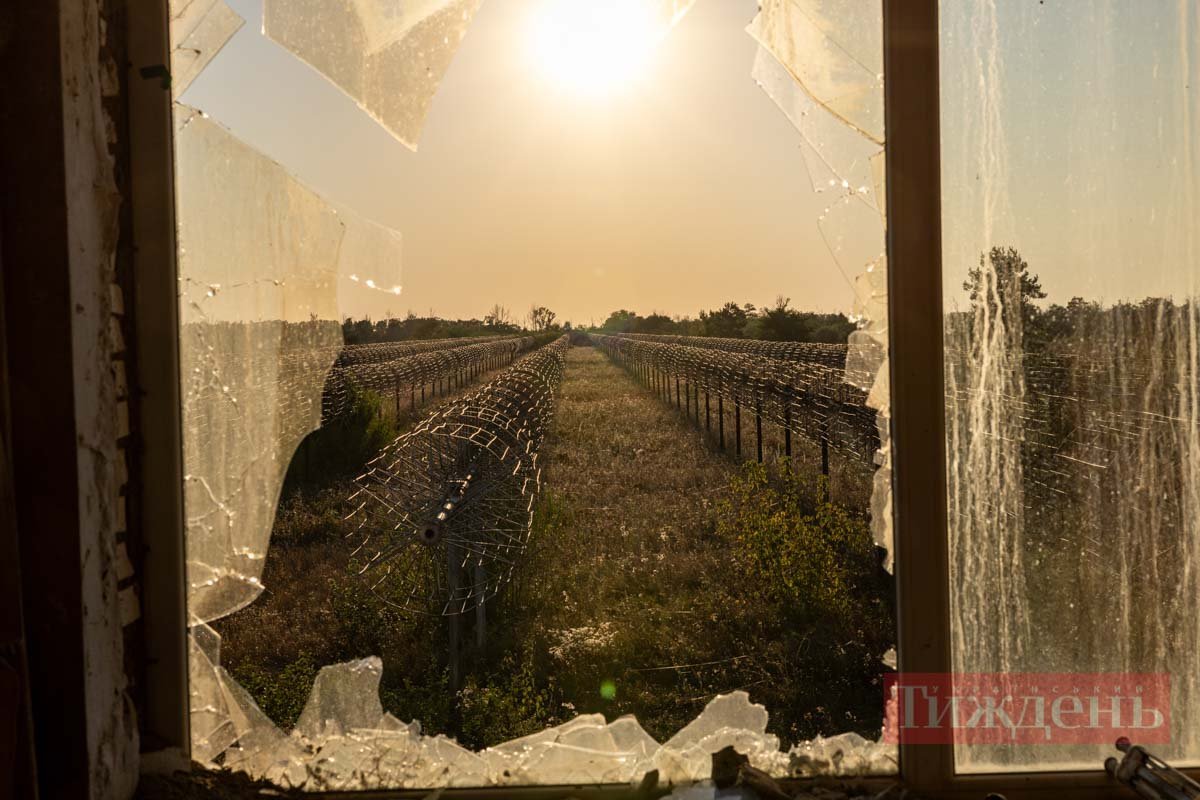
The "Ukrainian Week" has recently published an article about the attempting of scientists from the Radioastronomical Institute of the National Academy of Sciences of Ukraine (Kharkiv) to restore telescopes that were damaged by the Russians.
The world's largest low-frequency radio telescope, UTR-2, is located halfway between Chuguev and Izyum in the Kharkiv region. It was situated near the frontline. The observatory itself was in the occupied territory from the early days of the Russian invasion until September 2022 when Ukrainian forces reclaimed the land during a counteroffensive in the Kharkiv region.
Russian troops didn't just pass by the telescope; they turned the observatory building into a battalion command post. Deep trenches, positions for heavy equipment, and other remnants of their presence still surround the area. One of the storage facilities where astronomers kept their equipment was repurposed by the occupiers for ammunition storage. This is how the Russians transformed a scientific facility into a military one.
Recently, a solar power station with a capacity of 40,000 kWh per year was installed here. However, this energy supply is only sufficient during the summer when the telescope isn't operational. According to Vyacheslav Zakharenko, the director of the Radioastronomical Institute of the National Academy of Sciences of Ukraine and a corresponding member of the National Academy of Sciences of Ukraine, the telescope itself requires 60,000 to 70,000 kWh per year. During the winter, solar panels won't provide even the current energy supply. The installation of the solar power station is the most significant positive change that has occurred here. Its purchase was funded by the National Academy of Sciences of Ukraine.
Previously, foreign colleagues frequently visited the telescope, including Massimo Capaccioli, the former director of the Capodimonte Observatory and the ideologist of the largest-class Survey Telescope (DVT) in Chile, and Philippe Zarka, a researcher from the Paris Observatory. These visits weren't just gestures of politeness. UTR-2 and GURT (a more modern radio telescope deployed on the same territory) aren't museum exhibits.
Zarka attempted to detect exoplanets using the radio telescope, and although he wasn't successful, the principles on which Ukrainian radio telescopes are constructed later formed the basis for NenuFAR, a more recent French telescope. Ukrainian telescopes also contributed to the ground support of NASA's Juno mission for observing Jupiter. According to Vyacheslav Zakharenko, the next round of observations of Jupiter was scheduled for February 24 and 25, 2022, when the full-scale invasion began.
In the basement of the observatory, there used to be hardware and computer rooms for UTR-2, essentially the "heart" of the telescope. From here, underground passages stretched in various directions, where they laid antennas. All the equipment was either looted or utterly destroyed. Several mattresses and ubiquitous packages with the inscription "Russian Army" remain on the floor.
However, scientific activities haven't completely ceased here even now. Colleagues from abroad are lending their assistance. For example, French scientists have provided Ukrainian researchers with free access to their NenuFAR telescope.
To partially restore their potential, Ukrainian scientists can rely on European colleagues. The Radioastronomical Institute of the National Academy of Sciences of Ukraine has already applied for funding under the "Horizon Europe" program. The essence of the project is to integrate Ukrainian telescopes into the large European radio telescope LOFAR, which currently consists of stations for receiving signals located in eight EU countries. The same French NenuFAR telescope is already part of this project. To join, Ukrainian telescopes need to make some configuration changes and obtain a so-called LOFAR cabinet, which is an equipment complex for processing and transmitting signals to the unified system.
You can read the full version of the article by following the link.
Photo: Stanislav Kozlyuk
Share the news

